

The last 24 hours before NEET UG are not about studying. They’re about loading what you already know and walking in calm. Stop new chapters. Sleep 7-8 hours. Pack your admit card, the postcard-size photograph, original ID, and your dress-code-compliant clothes the night before. Eat light. Trust the work. That’s the whole strategy.
NEET UG is one paper, three hours, from 2 PM to 5 PM. 180 questions across Physics, Chemistry, Botany, and Zoology. Four marks per correct answer, minus one per wrong answer, 720 marks total. Reporting closes at 1:30 PM and after that the gate stays shut regardless of who’s outside or why. Around 24 lakh students will sit for it. Roughly 12 lakh will qualify. The difference between a top rank and a missed cutoff often comes down not to what students studied but to how they handled the 24 hours leading up to 2 PM on exam day.
We’ve watched it happen for years at Gurukul. A student who knew NCERT Biology backwards, scored 650+ in every mock, attended every Sunday class. Walks into the hall, fills the wrong row on the OMR sheet for 20 questions, panics, and ends with 580. The exam wasn’t the problem. The morning was.
Here’s what the last day should actually look like.
The night before: protect, don’t perform
You’re not preparing tonight. You’re loading.
Preparation is what you did over the last two years. Loading is what you do the night before. They look similar from the outside (both involve notes, both involve a desk). They’re entirely different in goal. Preparation means learning something new. Loading means putting the right things on top of your mental stack so they surface quickly tomorrow afternoon.
If you haven’t finished Human Reproduction or Coordination Chemistry yet, you’re not going to finish it tonight. Walk away. The cost of confusion at 2 PM tomorrow is far higher than the marks you might pick up by forcing it. Stick to what you know. Strengthen what’s already there.
Spend 2-3 hours on light revision, no more
This is the cap. Two to three hours total, spread across the day or done in one focused block. Don’t push past it.
What to actually revise:
Biology: This is where NEET is won. Open your NCERT, not your reference book. Skim chapter by chapter, especially the diagrams, the boxed information, and the in-text terms. The NEET examiner takes lines directly from NCERT — your job tonight is to recognise those lines instantly when you see them tomorrow. Focus on Plant Kingdom, Animal Kingdom, Human Physiology (Digestion, Circulation, Excretion, Neural Control), Reproduction, Genetics, and Biotechnology. Ecology is high-volume and high-yield. Re-read it.
Chemistry: Inorganic first. The periodic trends, the s-block and p-block exceptions, coordination compound colours and geometries, the qualitative analysis flowchart. Organic second. Named reactions, reagents, mechanisms you’ve already drilled. The IUPAC nomenclature rules for branched compounds. Physical Chemistry last. Just the formula sheet. Thermodynamics, kinetics, electrochemistry, equilibrium.
Physics: Your formula sheet. Don’t try to re-derive anything. Mechanics formulas, especially rotational motion. Electrostatics and current electricity. Modern Physics constants. Optics: sign conventions and mirror/lens formulas. Don’t solve a single problem. Just look at formulas and visualise where each variable comes from.
The rule we give every Gurukul student: the 5-second rule. If a fact, formula, or diagram doesn’t surface within 5 seconds of looking at the heading, mark it lightly and move on. Don’t sit with it. Don’t try to “really get it this time.” That’s exactly how you create a doubt loop that bleeds into the paper tomorrow.
Do not open a mock test
We’ve watched toppers do this. They sit down at 5 PM the day before, attempt a full 180-question mock to “stay sharp,” score 60 marks below their average because they’re already tense, and then spiral into the evening. Three hours of damage you can’t undo.
Mock tests in the final 48 hours don’t make you sharper. They give your brain one more emotional event to process. The same energy spent on light revision and rest will help you tomorrow far more.
If you absolutely need to hold a paper, take a previous year’s NEET question paper, scan through 10-15 questions across all four subjects, and just look at how they’re worded. That’s it. No solving.
Pack your kit: the things students forget
Do this at 8 PM, not 8 AM. Mental energy on exam morning is finite and you don’t want to spend any of it hunting for your admit card.
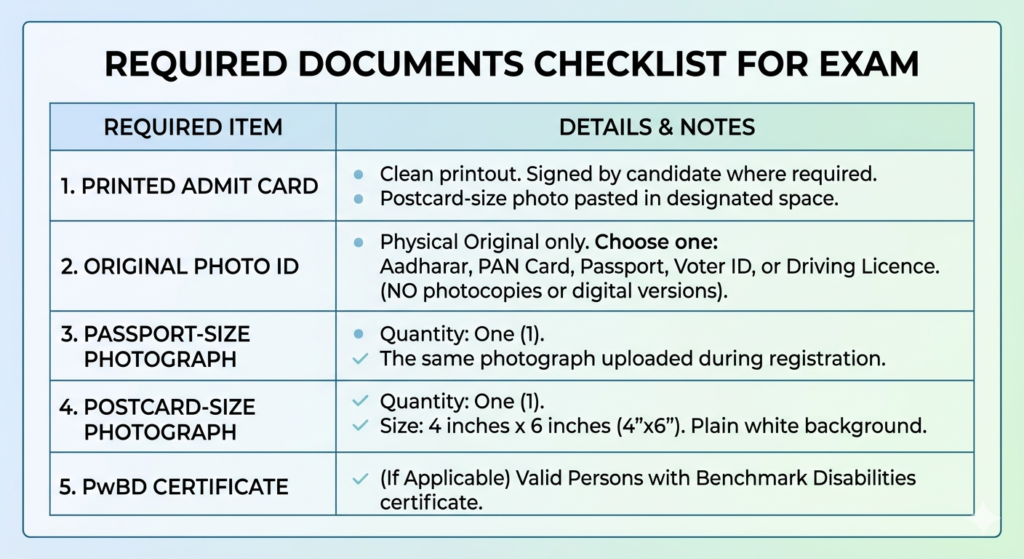
That’s all you take inside. No pens, no pencils, no water bottle (the centre provides one), no wallet, no phone, no smartwatch, no jewellery, no calculators. NEET is strict.
The photograph trap
Three students at our centre last year reached the gate with the wrong photograph. NEET requires two photographs and they have specific rules:
The passport photo must be the same one you uploaded during registration. Print it again if you’ve lost the original. Don’t substitute a different one.
The postcard-size (4×6 inch) photograph must be on a white background. Coloured backgrounds, even light blue, get questioned. Get this printed today if you haven’t already. Studios run out of the postcard size on Saturday evenings.
Both photos go in your hand or your folder. Not in your pocket. Folded photos cause problems at verification.
The dress code, set out the night before
NEET enforces dress code more strictly than any other Indian entrance exam. Lay out your clothes at 9 PM tonight so morning is mechanical.
For boys: half-sleeve plain shirt or t-shirt. Light-coloured trousers. Slippers or sandals, not shoes. No metal buttons. No jewellery. No watch. Empty pockets.
For girls: half-sleeve light kurti or top. Salwar or leggings. Slippers or sandals. No jewellery (one mangalsutra and bangles permitted for married candidates). No high heels. No metal hairpins. No watch.
If you wear religious or customary attire (turban, hijab, kirpan), you’ll be asked to reach the centre 60 minutes earlier than the standard reporting time so frisking can be done thoroughly. Build that into your schedule.
Test your outfit. Sit in it for 30 minutes this evening. If anything pinches, scratches, or rides up, change it now. Three hours of cumulative discomfort costs you marks.
Sleep by 10:30 PM
Seven to eight hours of sleep. The exam is in the afternoon, which makes some students think they can stay up late and “make up sleep” in the morning. They can’t. Disrupted sleep cycles distort cognition all day, not just in the first few hours.
A few rules that help:
- Phone in a different room from 10 PM onwards. No 11 PM Telegram groups, no checking how stressed your friends are.
- Skip caffeine after 4 PM.
- Skip motivational reels. They feel productive. They’re just cortisol spikes dressed up as motivation.
- A 10-minute walk at 9 PM helps you fall asleep faster than any breathing app.
If sleep doesn’t come, don’t fight it. Lie still with your eyes closed. Horizontal rest is roughly 80% as restorative as actual sleep. Don’t pick up your phone “just to check the time.”
What should I revise on the last day before NEET?
Revise only from your own notes, NCERT (especially Biology), and one-page formula sheets. Never open a new reference book the day before. Focus on high-yield areas: NCERT Biology lines and diagrams, Inorganic Chemistry exceptions and coordination compounds, Organic named reactions and reagents, Physics formulas, and your personal mistake log. Skim, don’t solve.
Exam morning: the long wait until 2 PM
NEET’s biggest hidden challenge isn’t the paper. It’s the long morning before the paper.
When the exam is in the afternoon, you have six hours of conscious time between waking up and walking into the hall. Six hours is enough time to over-revise, get anxious, eat badly, drink too much coffee, or read the wrong NEET forum post on Reddit. Most students don’t have a plan for the morning and that’s where they bleed energy.
Here’s the plan that works.
6:30 AM to 8 AM: wake gently, eat lightly
Wake up at 6:30 AM. Not earlier. Sleep is more valuable than two extra hours of dead morning.
Brush, shower (cool water if you can; it activates your nervous system better than coffee), and put on light clothes for the morning (not your exam outfit yet).
Breakfast at 7:30 AM. Light and familiar. Two parathas with curd. Or poha. Or idli and sambar. Or two slices of toast and a banana. Skip oily food, skip heavy ghee, skip a “power breakfast” you’ve never tried before. The goal is to feel light at 12 PM, not full.
8 AM to 11 AM: the quiet block
These three hours are where most students self-destruct. They try to “do one more revision.” They open WhatsApp. They scroll through last-minute YouTube tips. By 11 AM their brain is already exhausted.
A better protocol:
8 AM to 9 AM. One last gentle scan of your formula sheet or NCERT Biology table of contents. Just to remind your brain what’s in there. No solving. No deep reading.
9 AM to 10 AM. Stop revising. Walk for 30 minutes if your centre is nearby. Take a slow shower. Sit with a parent. Listen to music you like. Anything that isn’t NEET.
10 AM to 11 AM. Change into your exam outfit. Pack and re-check your folder one final time (admit card, ID, two photos). Have a small snack if you’re hungry. A glass of milk and a biscuit, or one banana. Nothing that needs digesting.
11 AM to 12:30 PM: the lunch question
This is genuinely tricky. The NEET paper starts at 2 PM and runs till 5. Eat too early and you’re hungry by 4 PM (when the toughest questions usually appear). Eat too late and you’re drowsy in the first hour.
Our recommendation: eat a real lunch between 11:30 AM and 12 noon. Make it light but solid. One chapati with dal and a vegetable. Or a small portion of rice with dal and curd. Or two idlis with sambar. Avoid biryani, paneer-heavy curries, chole bhature, anything fried. Skip cold drinks (sugar crashes at 3:30 PM). Skip excessive water in the half hour before you leave for the centre.
12:30 PM to 1 PM: reach the centre
The admit card says reporting closes at 1:30 PM. Treat 12:30 PM as your absolute target arrival.
Why this much margin matters:
- Frisking at NEET takes longer than at any other entrance exam. Handheld metal detectors, physical pat-down, biometric capture, signature on attendance sheet. If you’re wearing customary attire, even longer.
- If something is wrong with your admit card or photograph, you need 30 minutes to talk to the centre superintendent. A student at 1:25 PM has no time to fix anything.
- 24 lakh students appear for NEET. Centres are crowded. Parking is tight. The walk from the gate to your hall block can take 15 minutes.
If your centre is in a different city or a far locality, drive past it once the day before. Note the gate. Note where parents can wait. This 30-minute reconnaissance saves you 30 minutes of confusion on exam morning.
Inside the centre: the OMR setup is where you must be careful
Once you’re seated at your desk, the invigilator will hand you:
- The NEET test booklet (sealed)
- The OMR answer sheet
- The pen you must use (you cannot use your own pen for OMR)
You’ll get roughly 20-25 minutes between sitting down and the official 2 PM start. Use them well.
Fill the OMR header correctly. This is non-negotiable.
The OMR sheet has fields at the top for your roll number, test booklet code, test booklet number, name, signature, and barcode. You must fill each of these in pen and also bubble the corresponding digits below. Two minutes of careful work here prevents the catastrophe of a misread sheet at evaluation.
The fields students get wrong every year:
The test booklet code (a single letter or digit). Look at it twice. Bubble it.
The test booklet number (a 6-digit number printed on the booklet). Copy and bubble it digit by digit. Re-check.
The OMR sheet number (printed on your OMR). Copy and bubble.
Your roll number from the admit card. Don’t write it from memory. Copy from the admit card.
Sign the attendance sheet twice
NEET requires two signatures on the attendance sheet — one before the exam and one after. Students miss the second signature and get marked absent. The invigilator usually reminds the hall, but not always. Make a mental note now: sign twice.
Paste the second photograph
The invigilator will ask you to paste your postcard-size photograph on the attendance sheet. This is in addition to the one already on your admit card. Have both photos ready when you sit down.
The first 10 minutes of the paper: OMR strategy that prevents disasters
The single biggest career-killing mistake on NEET is bubbling the wrong row on the OMR sheet. A student answers question 7 correctly, but bubbles row 6 because their eye drifted. From question 7 onwards, every answer is shifted by one row. They lose 80-100 marks they had genuinely earned.
How to prevent this:
Bubble in batches of five, not one by one. Solve questions 1 to 5 on the booklet. Then move to the OMR sheet and bubble all five at once, while looking at the question number on the OMR with your finger or pen tip. Then solve 6 to 10. Bubble. Then 11 to 15. This is slower than question-by-question bubbling, but it eliminates row-shift errors entirely.
Use the pen they gave you to gently mark the booklet question number you’ve just bubbled. A small dot or tick. This way you always know where you are in the OMR sheet.
Fill the bubble completely. Dark, even, no white showing through. A partially filled bubble can read as ambiguous to the OMR scanner. Use 2-3 seconds per bubble, not half a second. Speed comes from the questions you skip, not from sloppy bubbling.
Do not change an answer unless you are 100% sure of the new one. NEET OMR doesn’t have correction fluid or a second chance. If you must change, ask the invigilator for a fresh OMR — they may or may not give one, and you’ll lose 15 minutes. Better to commit and move on.
How to spend three hours: section order and bio-break rules
NEET gives you 180 questions in 200 minutes (180 actual minutes plus 20 for OMR transfer). That’s roughly 1 minute per question.
The order most Gurukul students follow:
Biology first (45 minutes for Botany + 35 for Zoology). Biology is the highest-volume, fastest-attempting section. Knock it out while you’re fresh. Aim for 85-90 questions in 80 minutes.
Chemistry next (45 minutes). Inorganic flies. Organic takes more time. Physical Chemistry the most. Order within Chemistry: Inorganic first, Organic second, Physical last.
Physics last (50 minutes). Physics is where the calculations are. Save it for when the easy marks are already locked in.
This isn’t the only valid order. Many top scorers do Physics first when they’re freshest. Use whatever you’ve practised in your mock tests. The exam day is not the day to invent a new strategy.
The bio-break rule
NEET allows bio-breaks (washroom) during the paper, but with two restrictions:
- Not in the first hour (2 PM to 3 PM)
- Not in the last 30 minutes (4:30 PM to 5 PM)
When you return from a bio-break, biometric attendance is captured again and you’re frisked again. This takes 5-7 minutes you don’t have. Plan your fluid intake so you don’t need a bio-break at all. Empty your bladder before entering at 1:45 PM. Don’t drink water from your bottle inside until at least 3 PM.
Common mistakes students make in the last 24 hours
The ones we see every single year:
Trying one last chapter. A friend mentions Biotechnology was tested heavily last year and you panic-open the chapter at 11 PM. By 1 AM you’ve half-learned it and confused yourself on Genetics, which you actually knew. Net effect: 12 marks lost on questions you would’ve gotten right otherwise.
Wearing closed shoes “for comfort.” They get rejected at the gate. NEET dress code allows slippers and sandals only. We have seen students cry at the gate.
Carrying a digital watch or smartwatch. Rejected. Carry a wall-clock-style analog watch or no watch at all. The exam hall has a clock.
Drinking too much water at 1 PM. You sit in the hall at 1:45. You’re already feeling it by 2:30. Bio-break before 3 PM is not allowed. You spend the rest of the paper distracted.
Eating heavy at noon. A 1 PM food coma is a real thing. Your brain works at 70% capacity. Light, light, light.
Carrying photocopies of ID. Original only. Photocopies are rejected.
Setting one alarm. Set three. Different devices. Different times. The cost of an extra alarm is nothing. The cost of waking up at 11 AM and panicking is your entire year.
Reading NEET answer keys from last year on the morning of the exam. Don’t do this. Yesterday’s paper isn’t this year’s paper. Reading old answers fills your head with wrong patterns.
Discussing the morning paper with friends en route to the centre. Don’t. Walk in your own bubble.
Should I take a mock test the day before NEET?
No. Avoid full-length mock tests in the final 48 hours before NEET. A bad mock score the day before will shake your confidence right when you need it most, and a tired brain doesn’t actually get sharper from one more practice session. Use the time for light NCERT revision and rest.
How many hours of sleep do I need the night before NEET?
Aim for 7-8 hours, ideally going to bed by 10:30 PM and waking up by 6:30 AM. NEET is an afternoon paper, but disrupted sleep affects cognition all day, not just in the first few hours. Sleep is when your brain consolidates everything you’ve learned over two years. Skip it and you’ll feel it in Biology recall and Physics calculation speed.
Final word
The last 24 hours before NEET are won by students who do less, not more.
You’ve spent two years building this. You’ve solved tens of thousands of MCQs. You’ve sat through Sunday class after Sunday class. The work is done. What’s left is to walk in calm, fed, rested, and confident, and let the preparation do its job.
We’ve watched students with average mock scores beat their own ceilings on the actual day because they slept well, ate light, and stayed off their phones. We’ve also watched 680+ mock-scorers blow it because they crammed Biology till 2 AM and made OMR errors at 3 PM. The difference isn’t preparation. It’s how you handle these 24 hours.
You’ve got this. Sleep early. Eat light. Bubble carefully. Trust the work.
Gurukul Career Institute trains NEET and JEE aspirants in Moradabad with small batches and personalised mentoring. If you’re a Class 11 or 12 student preparing for NEET UG, or you’re considering a dropper year to attempt the exam again, reach out for a counselling session with our team.